News
[PUBLICATION] Stacked 2D and 1D Arrays Dual-Core Probe for Ultrasound-Guided Sonoporation
Dates
from July 4, 2026 to August 4, 2026
Coordinated by Jean-Michel Escoffre and Granted by Région Centre-Val de Loire
Stacked 2D and 1D Arrays Dual-Core Probe for Ultrasound-Guided Sonoporation
IEEE Transactions on Ultrasonics
J. Cloet1, R. Rouffaud1, F. Levassort1, M. Roy2, J.M. Escoffre2, D. Fouan2, M. Legros3, D. Certon11GREMAN UMR 7347, University of Tours, CNRS, INSA CVL, Tours, France
2INSERM, Imaging & Neuropsychiatry iBraiN U1253, University of Tours, Tours, France
3Vermon S.A. Tours, France
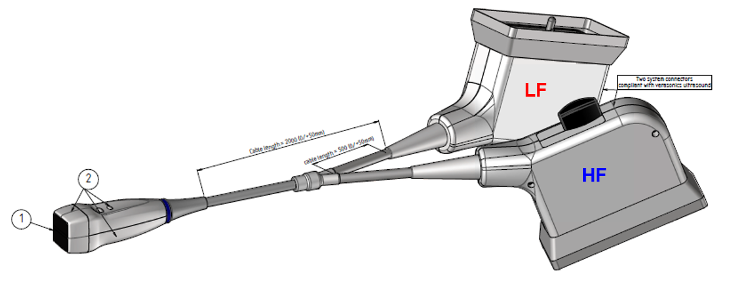
Abstract - Sonoporation represents a promising drug delivery modality in oncology. This modality consists of insonifying the targeted tissue with a low-frequency ultrasound beam (typically 1 MHz) following the intravenous injection of gas microbubbles. Activation of these microbubbles under the influence of the ultrasound field increases the permeability of biological barriers, thereby facilitating the passage of therapeutic agents and enhancing their therapeutic efficiency. To support this type of image-guided therapy, a bi-modal probe was designed and characterized. This probe combines a 128-element linear array (1-3 piezocomposite, single-crystal-based) with a central frequency of 20 MHz for high-resolution imaging, and a 16 x 16 matrix array (1-3 piezocomposite, PZT-based) operating at 1 MHz for therapy. To assess the probe’s suitability for the intended application, an initial acoustic and electrical characterization campaign was conducted. This included determining elementary directivities to refine an acoustic radiation model (DREAM). Safety considerations were central to the evaluation and temperature monitoring confirmed that heating remained within acceptable limits. The acoustic properties of the high-frequency imaging array were thoroughly assessed and compared with those of commercial probe, demonstrating that the stacking of two transducers did not compromise imaging performances. Furthermore, the probe’s design enables focused scanning to extend the insonified zone without increasing the temperature - a particularly relevant feature for in-vivo applications. To this end, four beamforming strategies were investigated for the matrix array. Finally, an initial series of in-vitro experiments confirmed that the probe effectively induces the expected sonoporation effects.
Contact :
Jean-Michel Escoffre : jean-michel.escoffre@inserm.fr