News
[PUBLICATION] Invariant response to faces in ASD: Unexpected trajectory of oculo-pupillometric biomarkers from childhood to adulthood
Dates
from November 27, 2025 to December 27, 2025
with Camille Riou unde the scientific supervision of Nadia Aguillon-Hernandez & Claire Wardak
We are very proud to share the publication of our latest article in Brain Research: “Invariant response to faces in ASD: Unexpected trajectory of oculo-pupillometric biomarkers from childhood to adulthood”
Web link: https://www.sciencedirect.com/science/article/pii/S000689932500633X
This work was conducted by Camille Ricou, recent PhD graduate of the AutisM team, under the co-supervision of Claire Wardak (Researcher, Inserm) and Nadia Aguillon-Hernandez (Associate Professor, Université de Tours), with the contribution of our clinical and engineering collaborators at iBraiN.
�� What this study shows
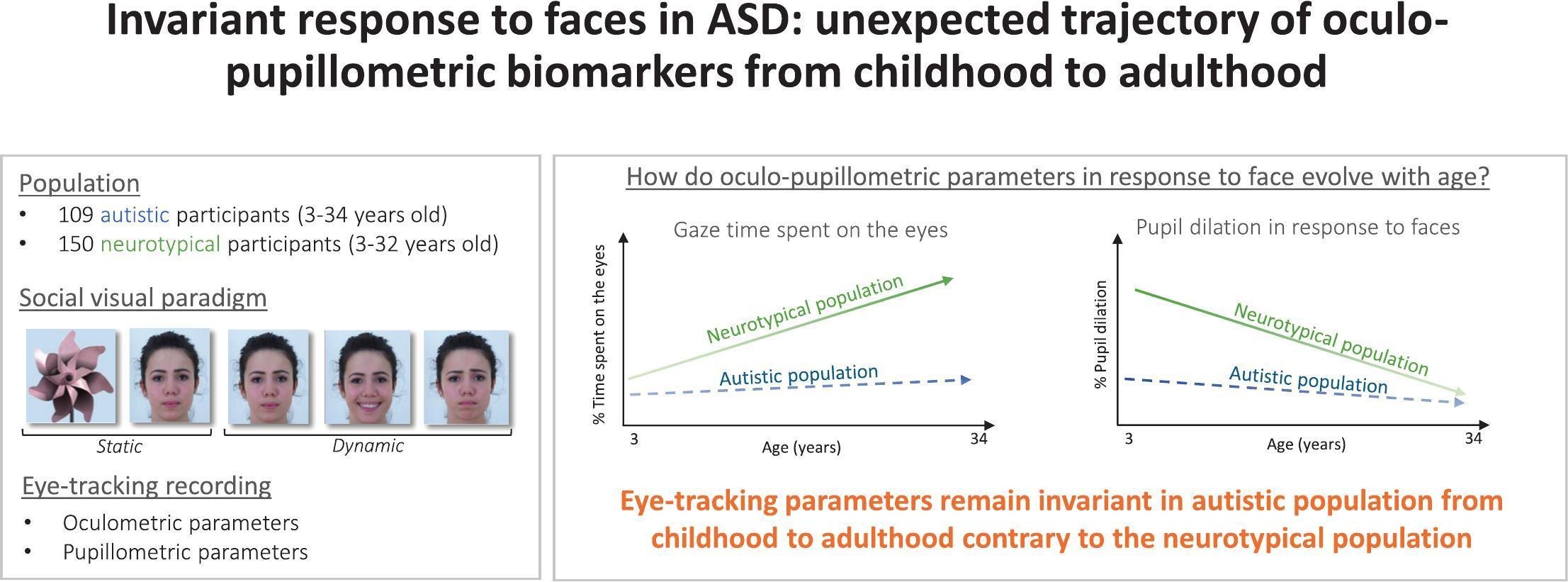
Using eye-tracking in more than 250 participants aged 3 to 34 years, the study characterizes how gaze patterns and pupil dilation in response to faces evolve — or fail to evolve — across development.
Key findings (from the paper, pages 1–3 and 12–15) :
• Neurotypical participants show strong developmental maturation:
– increasing attention to the eye region with age,
– and decreasing pupil reactivity to dynamic faces (reflecting maturing arousal and attentional systems).
• Autistic participants show a strikingly invariant trajectory from childhood to adulthood:
– no developmental increase in attention to faces or eyes,
– and stable, low pupil reactivity across all ages.
• These distinct developmental profiles suggest not only differences in processing, but differential maturation trajectories in ASD.
• Oculometric and pupillometric measures show promising age-dependent biomarker potential for screening and monitoring ASD.
This work provides one of the most detailed lifespan characterizations of face-processing trajectories in autism, offering new insight into how early atypicalities may lead to divergent developmental paths.
Huge congratulations to Camille for this impressive work, and to Claire and Nadia for their exceptional supervision — a beautiful example of rigorous, translational research within our AutisM/iBraiN Inserm Lab.
#Neuroscience #AutismResearch #ASD #SensoryProcessing #Neurodevelopment #iBraiN #ResearchExcellence
Web link: https://www.sciencedirect.com/science/article/pii/S000689932500633X
This work was conducted by Camille Ricou, recent PhD graduate of the AutisM team, under the co-supervision of Claire Wardak (Researcher, Inserm) and Nadia Aguillon-Hernandez (Associate Professor, Université de Tours), with the contribution of our clinical and engineering collaborators at iBraiN.
�� What this study shows
Using eye-tracking in more than 250 participants aged 3 to 34 years, the study characterizes how gaze patterns and pupil dilation in response to faces evolve — or fail to evolve — across development.
Key findings (from the paper, pages 1–3 and 12–15) :
• Neurotypical participants show strong developmental maturation:
– increasing attention to the eye region with age,
– and decreasing pupil reactivity to dynamic faces (reflecting maturing arousal and attentional systems).
• Autistic participants show a strikingly invariant trajectory from childhood to adulthood:
– no developmental increase in attention to faces or eyes,
– and stable, low pupil reactivity across all ages.
• These distinct developmental profiles suggest not only differences in processing, but differential maturation trajectories in ASD.
• Oculometric and pupillometric measures show promising age-dependent biomarker potential for screening and monitoring ASD.
This work provides one of the most detailed lifespan characterizations of face-processing trajectories in autism, offering new insight into how early atypicalities may lead to divergent developmental paths.
Huge congratulations to Camille for this impressive work, and to Claire and Nadia for their exceptional supervision — a beautiful example of rigorous, translational research within our AutisM/iBraiN Inserm Lab.
#Neuroscience #AutismResearch #ASD #SensoryProcessing #Neurodevelopment #iBraiN #ResearchExcellence
Contact :
Claire Wardak : claire.wardak@inserm.fr