News
[PUBLICATION] Reversible & Microbubble Concentration-Dependent Permeabilization of an In Vitro Human Endothelial Barrier to Small Molecules Using Ultrasound: Implications for Neurodegenerative Diseases Therapy
Dates
from June 6, 2026 to July 6, 2026
with Karen Ea, Margot Pinaud, Damien Fouan, Jean-Yves Tartu, Hélène Blasco, Philippe Corcia, Patrick Vourc’h and Jean-Michel Escoffre from our lab !
Reversible & Microbubble Concentration-Dependent Permeabilization of an In Vitro Human Endothelial Barrier to Small Molecules Using Ultrasound: Implications for Neurodegenerative Diseases Therapy
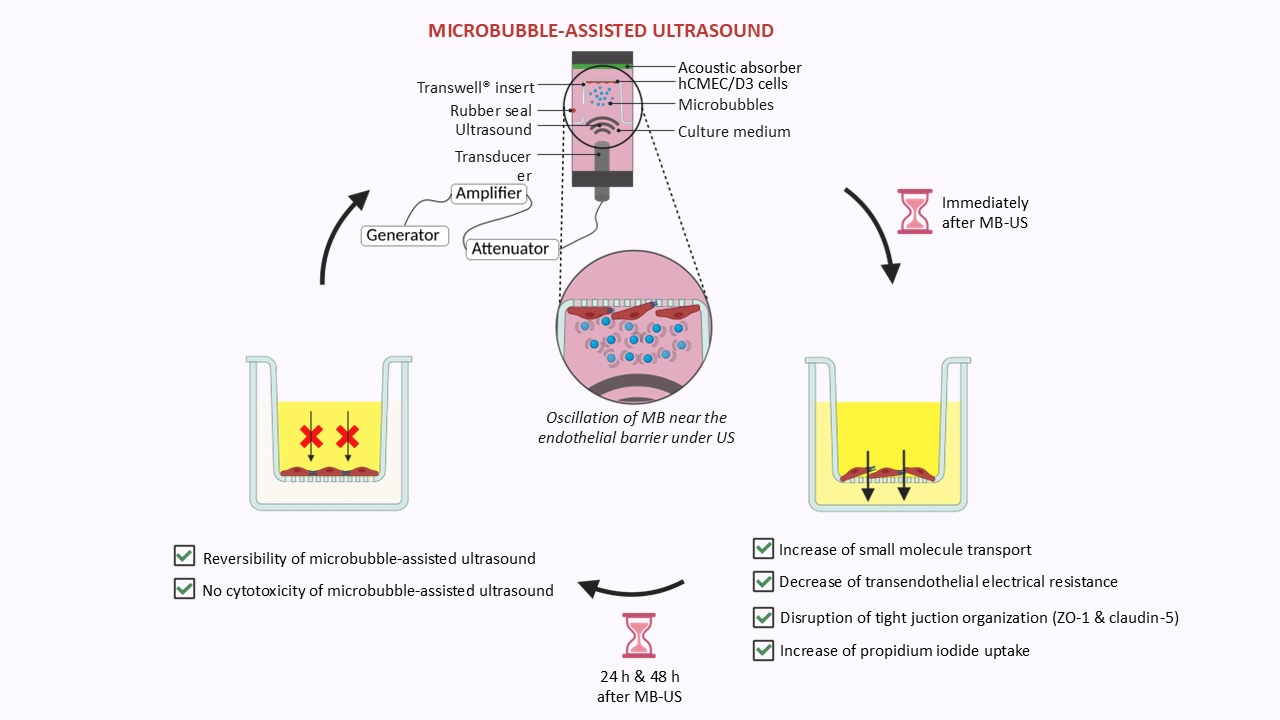
Karen Ea, Margot Pinaud, Damien Fouan, Antoine Presset, Jean-Yves Tartu, Noboru Sasaki, Nicolas Taulier, Wladimir Urbach, Christiane Contino-Pépin, Stéphane Desgranges, Hélène Blasco, Philippe Corcia, Patrick Vourc’h and Jean-Michel EscoffreAbstract - The blood–brain barrier (BBB) is a highly selective interface that protects the brain from circulating pathogens and toxins, but this selectivity also restricts the delivery of therapeutic agents to the central nervous system. Microbubble-assisted ultrasound (MB-assisted US) has emerged as a promising noninvasive and localized strategy to modulate BBB permeability and enhance drug delivery. This study investigated the ability of MB-assisted US to permeabilize an in vitro endothelial barrier model and promote the transport of small molecules, with particular attention to the influence of MB concentration and the reversibility of permeability changes. Immortalized human cerebral microvascular endothelial hCMEC/D3 cells were cultured on Transwell® inserts to form a confluent monolayer. Vevo MicroMarker® microbubbles were added to the apical compartment, and an US sequence (1 MHz, 1 ms PRP, 5% DC, 400 kPa PNP, 2 min) was applied. Barrier integrity and permeability were assessed using transendothelial electrical resistance (TEER), lucifer yellow (LY) permeability, and propidium iodide (PI) uptake assays. Tight junction (TJ) organization was evaluated by immunofluorescence staining of zonula occludens-1 (ZO-1) and claudin-5, and cell viability was assessed using complementary cytotoxic assays. MB-assisted US induced a significant and immediate decrease in TEER, accompanied by increased LY transport and localized PI uptake above a defined MB concentration threshold. These functional changes correlated with a reversible alteration of TJ architecture. Barrier function and TJ organization progressively returned to baseline within 24–48 h, and no cytotoxic effects were observed. Overall, these results demonstrate that MB-assisted US induces a microbubble concentration-dependent and reversible endothelial permeability to small molecules in an in vitro model, highlighting its potential for controlled drug delivery strategies targeting neurodegenerative disease.
Molecular Pharmaceutics - https://pubs.acs.org/doi/full/10.1021/acs.molpharmaceut.6c00168
Contact :
Jean-Michel Escoffre : jean-michel.escoffre@inserm.fr